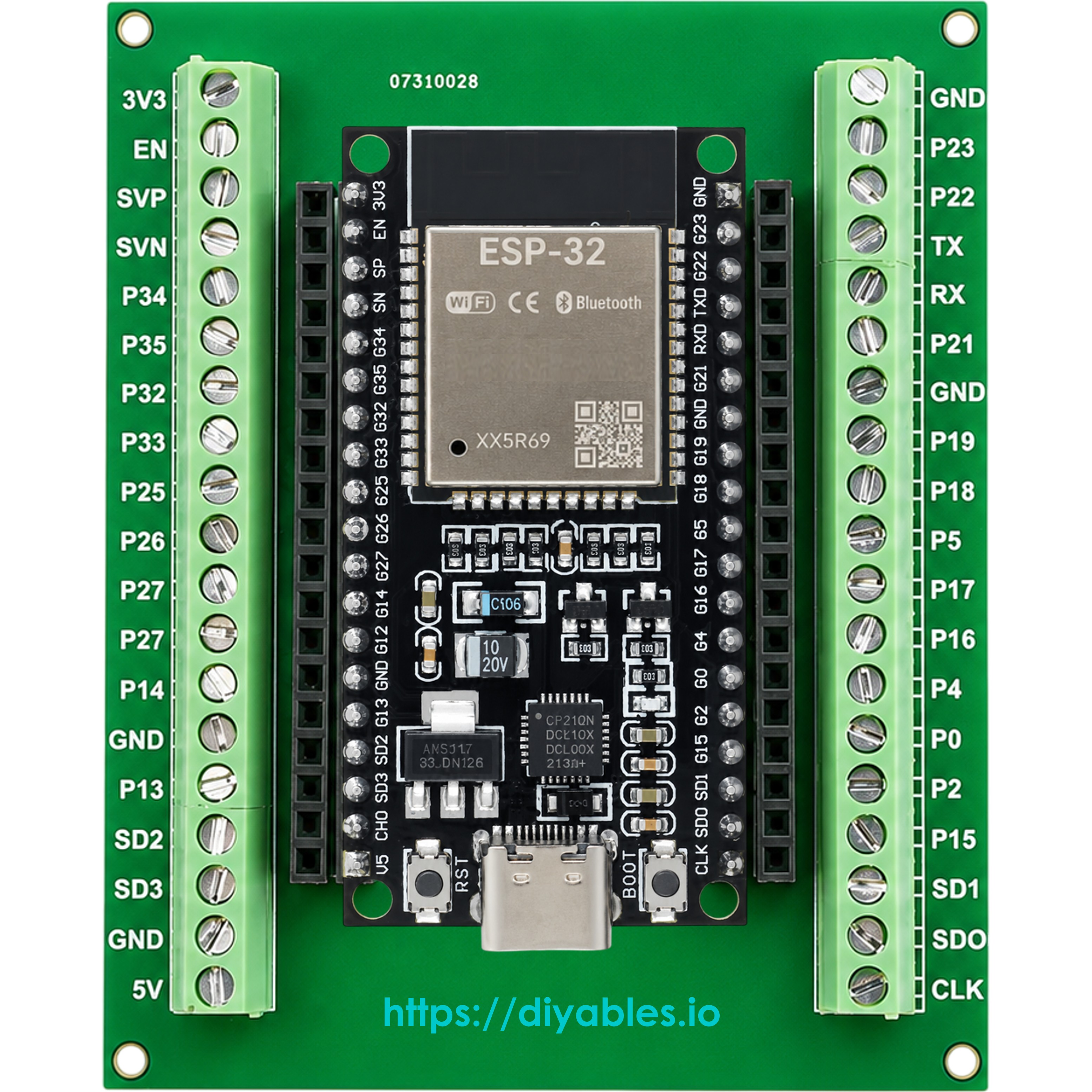
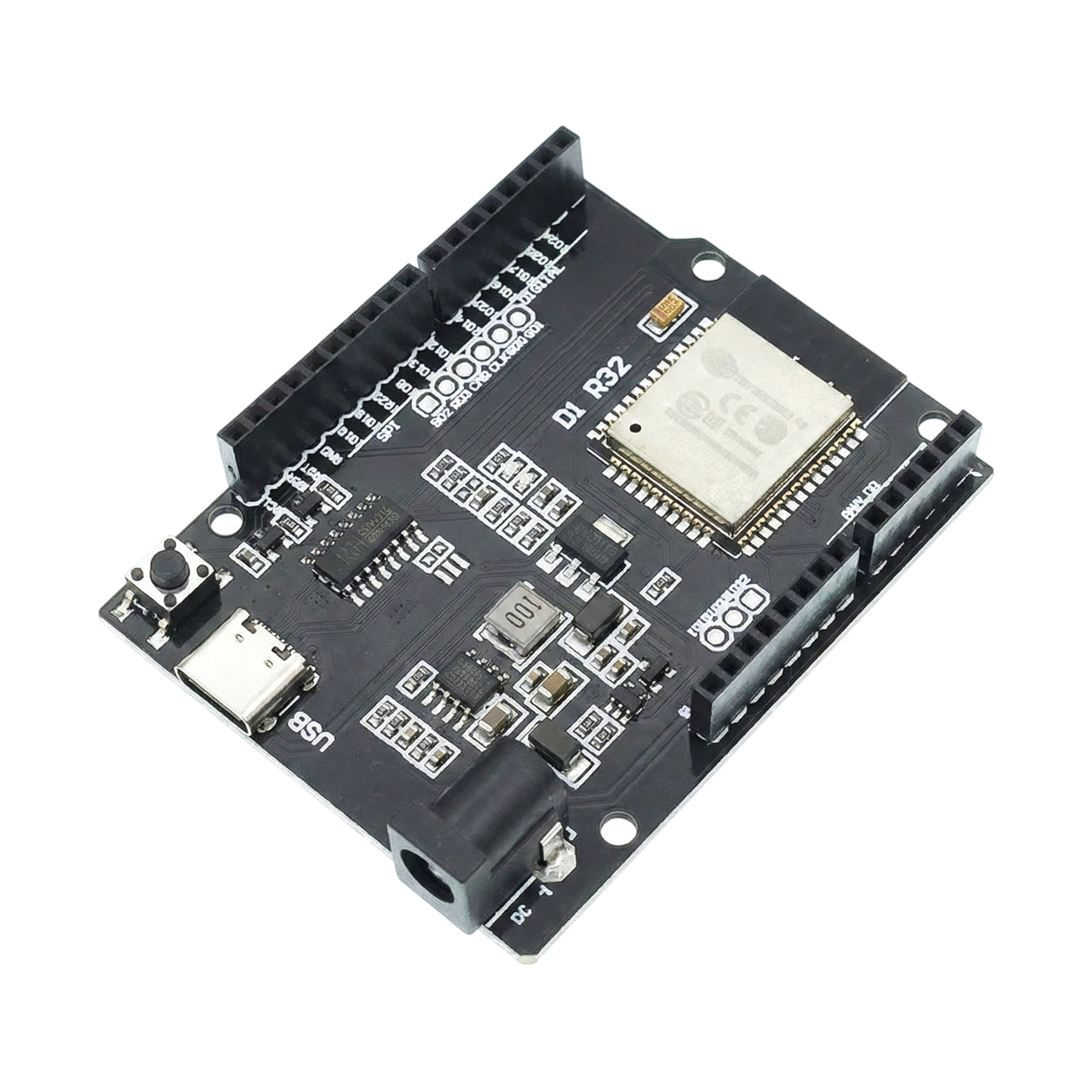
DIYables ESP32-WROOM-32 Development Board, Compatible with Uno Form Factor Shields WiFi Bluetooth, CH340 USB Type C, 4MB Flash
 Click to zoom


Quick Overview
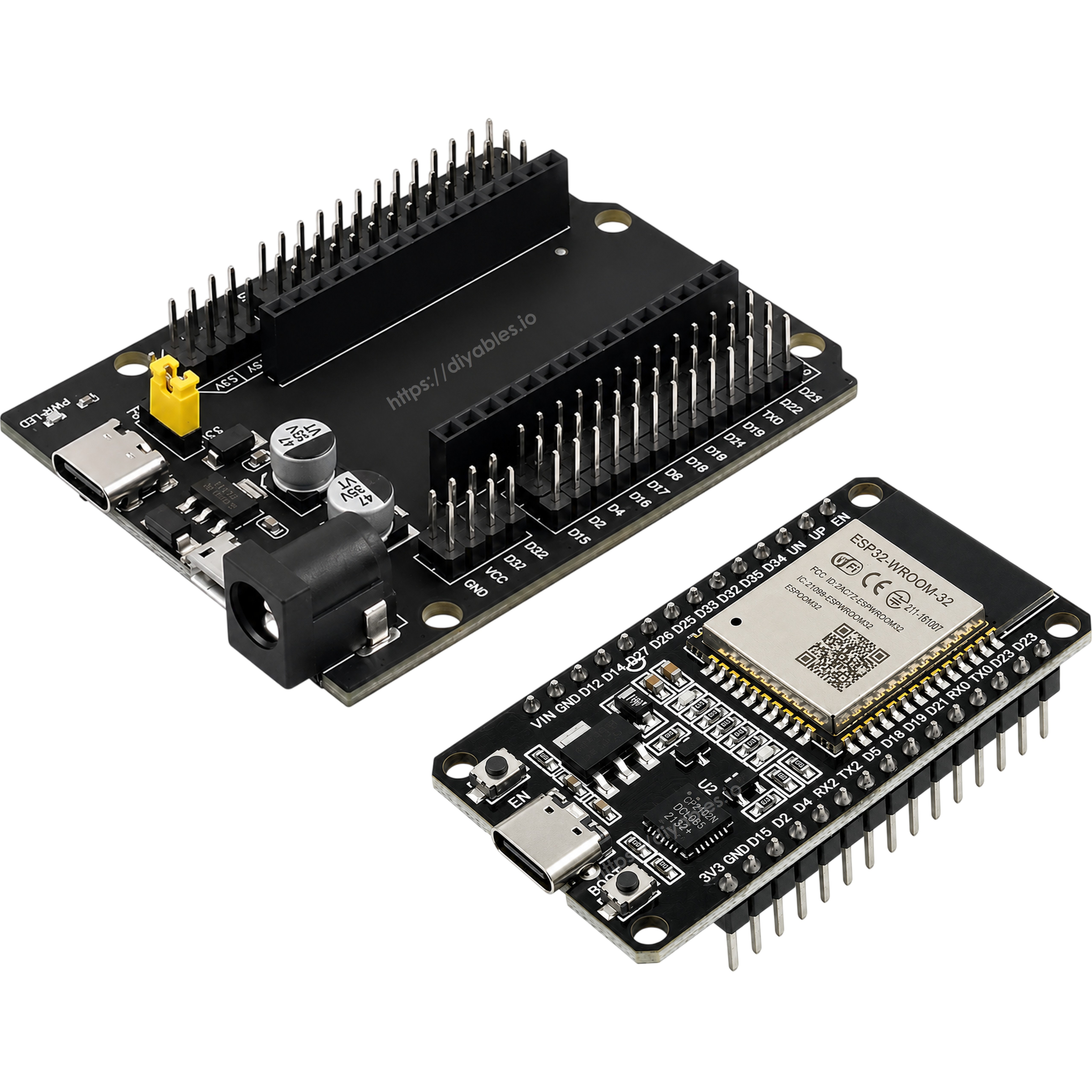
The DIYables ESP32-WROOM-32 Development Board combines the power of the original ESP32-WROOM-32 module with Arduino Uno form factor compatibility, making it the perfect upgrade for existing Arduino projects. Featuring a dual-core Tensilica LX6 processor with built-in 2.4 GHz WiFi and Bluetooth connectivity, this board delivers reliable IoT performance while maintaining physical compatibility with many Uno-style shields. The CH340 USB-to-serial chip and modern USB Type-C connector ensure easy programming and stable data communication with Arduino IDE, ESP-IDF, PlatformIO, MicroPython, and other development platforms.
This development board includes 4MB flash memory for program storage and supports a wide power input range of 5V to 12V for flexible powering options. The Uno form factor design allows you to use many existing Arduino Uno shields directly, including display shields, motor drivers, sensor arrays, and expansion boards, while gaining ESP32's advanced wireless capabilities. The board includes one analog input with a maximum signal of 3.2V for sensor integration, along with multiple GPIO, PWM, UART, SPI, and I2C interfaces for connecting various peripherals.
Ideal for upgrading Arduino Uno projects with WiFi and Bluetooth connectivity, building IoT smart devices, home automation systems, wireless sensor networks, and embedded development projects. Perfect for makers transitioning from Arduino to ESP32 while maintaining shield compatibility, educators teaching IoT and wireless programming, and developers prototyping commercial IoT products. The combination of Uno compatibility and ESP32-WROOM-32 wireless capabilities makes this board versatile for both educational and professional applications with multiple development framework support.
Key Features
- Original ESP32-WROOM-32 Module — Dual-core Tensilica LX6 processor with built-in WiFi and Bluetooth
- Uno Form Factor Compatible — Physical layout matches Arduino Uno for direct use with many Uno-style shields
- CH340 USB-to-Serial Chip — Reliable USB communication for programming and serial monitoring
- USB Type-C Connector — Modern USB Type-C interface for convenient programming and power
- 4MB Flash Memory — Ample storage for programs and data logging applications
- Wide Power Input Range — Supports 5V to 12V DC input for flexible powering options
- Built-in WiFi — 2.4 GHz WiFi 802.11 b/g/n for wireless connectivity
- Bluetooth Support — Bluetooth Classic and BLE for wireless communication
- Analog Input — One analog input with 3.2V maximum signal for sensor integration
- Rich GPIO Resources — Multiple GPIO, PWM, UART, SPI, I2C interfaces for peripherals
- Arduino IDE Compatible — Easy programming with Arduino IDE after board package installation
- Multi-Platform Support — Works with ESP-IDF, PlatformIO, MicroPython, and CircuitPython
- Shield Compatibility — Use existing Arduino Uno shields for displays, motors, sensors, and expansion
- Tutorial Support — Comprehensive ESP32 tutorials for WiFi, Bluetooth, web servers, and IoT projects
- Versatile Applications — Perfect for IoT projects, smart home automation, wireless communication, and embedded systems
- ...NOTE
- The analog input on this board has a maximum signal of 3.2V. If you need to read higher voltages, use a voltage divider. Additionally, you may need to configure the ADC with 11 dB attenuation for optimal analog sensor readings.
- ...NOTE
SPECIFICATION
| Specification | Value |
|---|---|
| Product Type | ESP32-WROOM-32 Development Board (Uno-Compatible Form Factor) |
| Module | ESP32-WROOM-32 |
| Processor | Dual-core Tensilica LX6 microprocessor |
| Clock Speed | Up to 240 MHz |
| SRAM | 520 KB |
| Flash Memory | 4 MB |
| WiFi | 2.4 GHz IEEE 802.11 b/g/n |
| Bluetooth | Bluetooth Classic and BLE |
| USB Interface | USB Type-C |
| USB-to-Serial Chip | CH340 |
| Form Factor | Arduino Uno-compatible layout |
| Shield Compatibility | Supports many Arduino Uno form factor shields |
| GPIO Pins | Multiple GPIO pins with various functions |
| Analog Input | 1 channel (3.2V maximum signal) |
| PWM Channels | Multiple PWM outputs |
| UART | Multiple UART interfaces |
| SPI | Multiple SPI interfaces |
| I2C | Multiple I2C interfaces |
| Operating Voltage | 3.3V (regulated from input) |
| Input Voltage | 5V to 12V DC |
| Operating Current | ~80mA (typical, excluding peripherals) |
| Dimensions | 68mm x 53mm (approx., Uno-compatible size) |
| Package Quantity | 1 piece |
| Compatibility | Arduino IDE, ESP-IDF, PlatformIO, MicroPython, CircuitPython |
| Applications | IoT projects, smart home automation, wireless communication, Arduino shield projects, embedded systems, WiFi/Bluetooth applications |
PIN MAPPING
The board keeps the Arduino Uno header layout while mapping each pin to an ESP32-WROOM-32 GPIO. In Arduino IDE, use the GPIO number (not the Uno pin name) in your code.
Digital Pins
| Uno Pin | ESP32 Pin | GPIO | Notes |
|---|---|---|---|
| D0 (RX) | RX0 | GPIO3 | UART0 RX |
| D1 (TX) | TX0 | GPIO1 | UART0 TX |
| D2 | IO26 | GPIO26 | DAC2 |
| D3 | IO25 | GPIO25 | DAC1 |
| D4 | IO17 | GPIO17 | UART2 TX |
| D5 | IO16 | GPIO16 | UART2 RX |
| D6 | IO27 | GPIO27 | – |
| D7 | IO14 | GPIO14 | – |
| D8 | IO12 | GPIO12 | Strapping pin (keep LOW at boot) |
| D9 | IO13 | GPIO13 | – |
| D10 | IO5 | GPIO5 | SPI SS, strapping pin |
| D11 | IO23 | GPIO23 | SPI MOSI |
| D12 | IO19 | GPIO19 | SPI MISO |
| D13 | IO18 | GPIO18 | SPI SCK |
I2C Pins
| Uno Pin | ESP32 Pin | GPIO | Notes |
|---|---|---|---|
| SDA | SDA | GPIO21 | I2C SDA |
| SCL | SCL | GPIO22 | I2C SCL |
Analog Pins
| Uno Pin | ESP32 Pin | GPIO | Notes |
|---|---|---|---|
| A0 | IO2 | GPIO2 | ADC2_2, strapping pin |
| A1 | IO4 | GPIO4 | ADC2_0 |
| A2 | IO35 | GPIO35 | ADC1_7, input only |
| A3 | IO34 | GPIO34 | ADC1_6, input only |
| A4 | IO36 | GPIO36 | ADC1_0, input only |
| A5 | IO39 | GPIO39 | ADC1_3, input only |
Power Pins
| Uno Pin | ESP32 Pin | Notes |
|---|---|---|
| IOREF | 5V | 5V output |
| RESET | RST | Reset (EN) |
| 3V3 | 3V3 | 3.3V |
| 5V | 5V | 5V |
| GND | GND | Ground |
| GND | GND | Ground |
| VIN | VIN | 5–12V input |
Other Pins
| Uno Pin | ESP32 Pin | GPIO | Notes |
|---|---|---|---|
| AREF | RST | – | Reset (EN), connected to RESET |
| GND (digital row) | GND | – | Connected to the other GND pins |
| NC (power row) | IO0 | GPIO0 | BOOT strapping pin |
Extra GPIO Pins
The board also provides extra solder holes with no Uno equivalent:
Above the Power Header:
| ESP32 Pin | GPIO | Notes |
|---|---|---|
| IO15 | GPIO15 | ADC2_3, strapping pin |
| IO33 | GPIO33 | ADC1_5 |
| IO32 | GPIO32 | ADC1_4 |
Under the Digital Header (Flash Pins — Do Not Use):
| ESP32 Pin | GPIO |
|---|---|
| SD2 | GPIO9 |
| SD3 | GPIO10 |
| CMD | GPIO11 |
| CLK | GPIO6 |
| SD0 | GPIO7 |
| SD1 | GPIO8 |
WARNING
Differences from a real Arduino Uno:
- The AREF position is RST (Reset / EN), not an analog reference.
- The IOREF position provides 5V.
- The unused NC position is IO0, the BOOT pin.
- A2–A5 (GPIO35, GPIO34, GPIO36, GPIO39) are input only and cannot be used as outputs.
- A0, D8, D10 and the IO15 hole are strapping pins. Avoid driving them at boot.
- The SD2, SD3, CMD, CLK, SD0, SD1 holes are connected to the onboard flash. Do not use them.
COMPATIBLE HARDWARE
- Arduino Uno Shields — Most Uno form factor shields including displays, motor drivers, and sensor shields
- LCD Shield (16x2, 20x4) — Character display shields with button interface
- Motor Driver Shields (L293D, L298N) — DC motor and stepper motor control shields
- Sensor Shield V5 — Expansion shield for easy sensor connections
- Ethernet Shield — Add wired network connectivity to WiFi/Bluetooth
- SD Card Shield — Data logging and file storage expansion
- Relay Shield — High-power device control with multiple relays
- Prototype Shield — Custom circuit development on Uno-compatible board
- Temperature and Humidity Sensors (DHT11, DHT22, BME280) — I2C and digital sensors
- OLED and LCD Displays — I2C and SPI displays for visual feedback
- Motion Sensors (PIR, Ultrasonic) — Digital GPIO interface for detection
- Servo Motors — PWM control for precise positioning
- LED Strips (WS2812B, NeoPixel) — PWM and digital control for RGB lighting
- GPS Modules — UART interface for location tracking
- Motor Driver Modules (L298N, TB6612) — PWM control for DC and stepper motors
- Bluetooth Peripherals — BLE sensors, keyboards, and game controllers
FRITZING PART
- Download DIYables ESP32 Uno Fritzing Part (.fzpz) — Import into Fritzing to draw wiring diagrams and breadboard layouts with this board