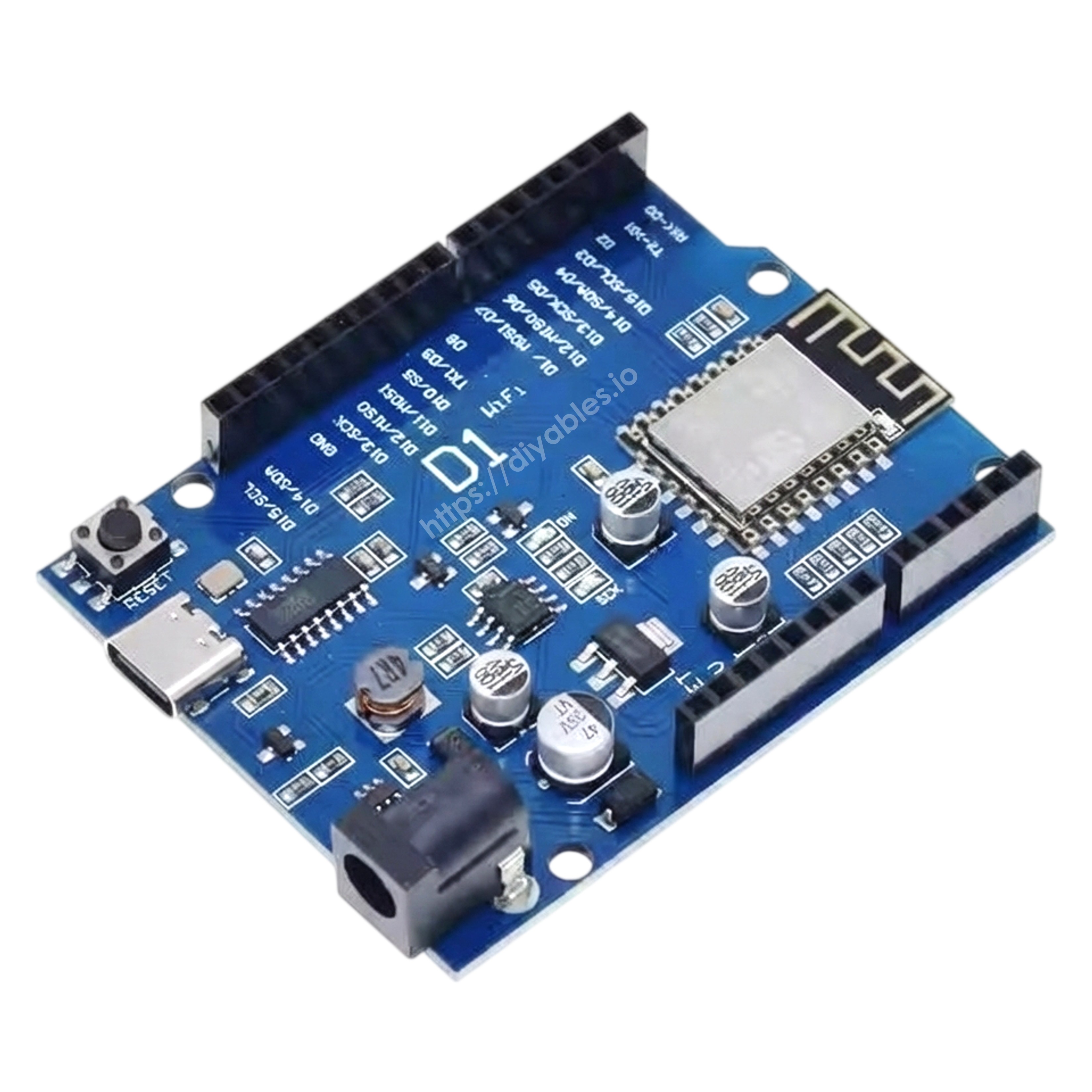
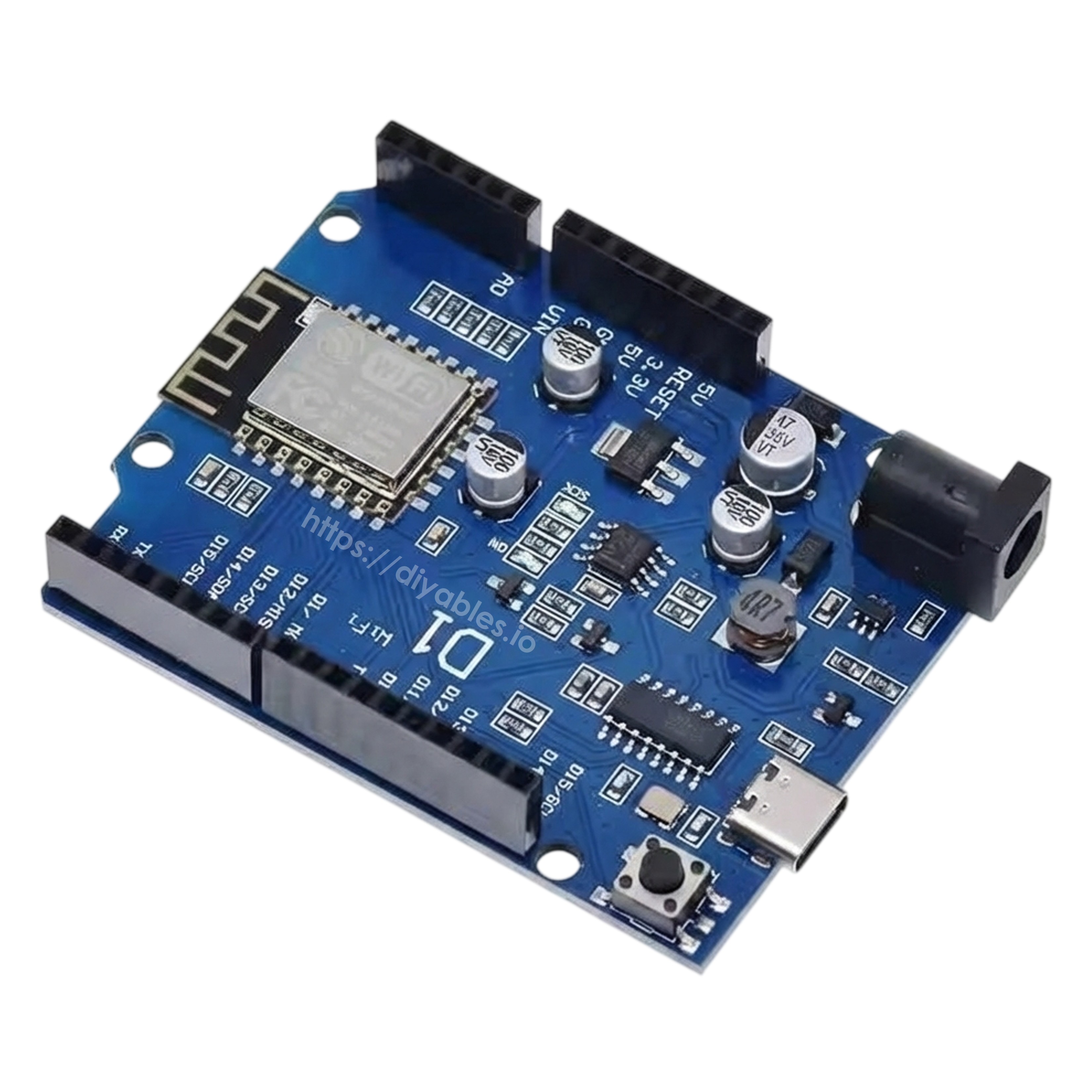
DIYables ESP8266 ESP-12 Development Board, Uno-Compatible Form Factor, Works with Arduino IDE
 Click to zoom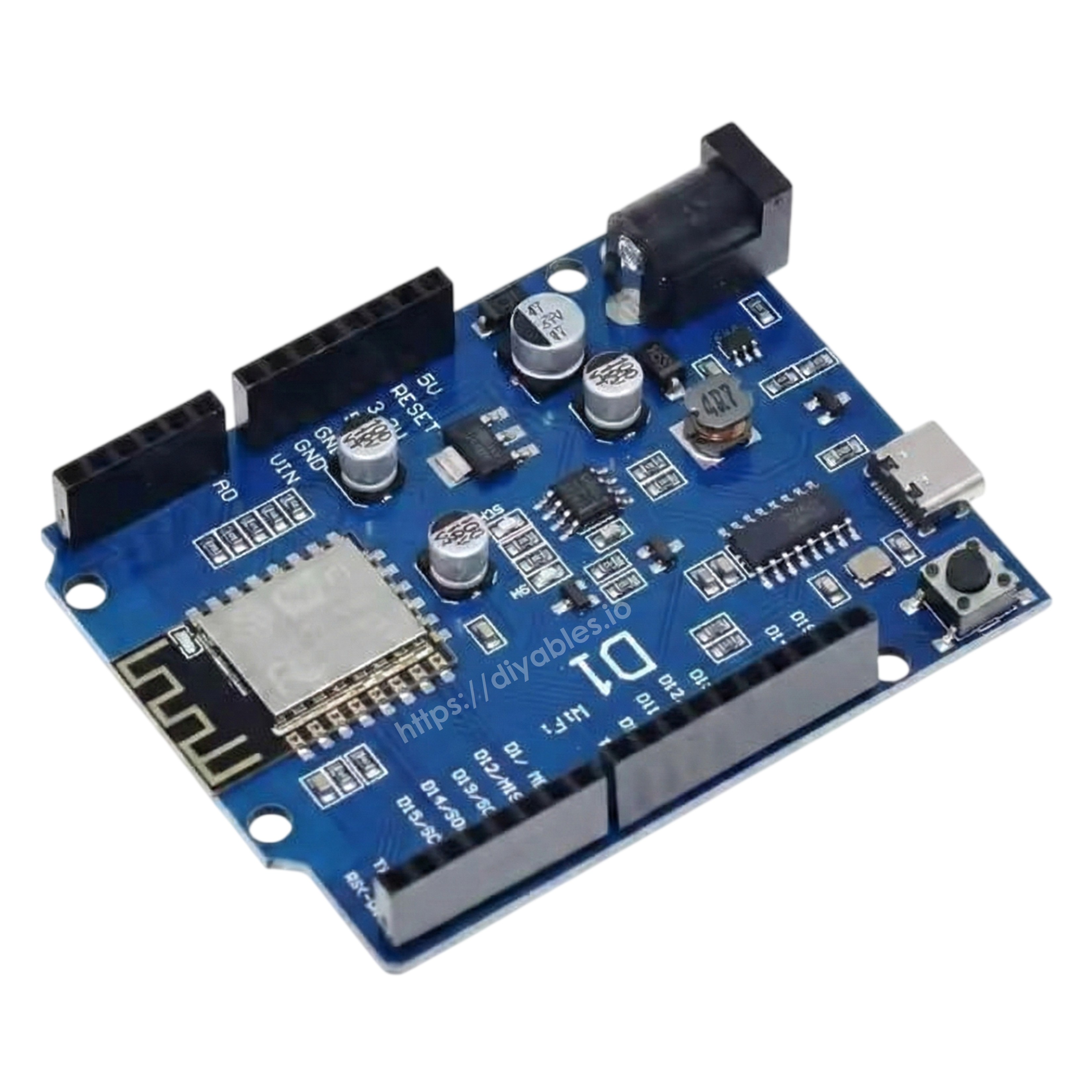
Quick Overview
The DIYables ESP8266 ESP-12 Development Board combines the powerful ESP8266EX WiFi microcontroller with an UNO-compatible form factor for seamless integration with Arduino shields and standard project enclosures. Built on the ESP8266EX chip with strong wireless capability and fast processing, this board is perfect for IoT, smart home, and web-connected projects. Fully supported in the Arduino IDE after installing the ESP8266 board package, it makes WiFi development simple for both beginners and advanced users.
This development board provides 11 digital IO pins and 1 ADC pin with 0-3.3V input range for connecting sensors, modules, and general electronics. The integrated 5V 1A switching regulator accepts input voltage up to 24V, ensuring stable embedded operation across various power sources. Support for OTA (Over-The-Air) wireless uploads enables convenient code updates without USB connection, making it ideal for deployed projects and remote devices.
Perfect for WiFi-enabled projects, IoT devices, home automation, remote monitoring, sensor networks, web servers, MQTT applications, and smart control systems. The UNO-compatible layout allows easy prototyping with existing Arduino shields and accessories. Ideal for makers and developers looking to add WiFi connectivity to their projects using the familiar Arduino IDE programming environment.
Key Features
- UNO-Compatible Form Factor — Designed with an UNO-style layout for easy prototyping and compatibility with standard shields and project enclosures
- ESP8266 WiFi Performance — Built on the ESP8266EX with strong wireless capability and fast processing for IoT, smart home and web-connected projects
- Works with Arduino IDE — Fully supported in the Arduino IDE after installing the ESP8266 board package, making development simple for beginners and advanced users
- Versatile IO Options — Provides 11 digital IO pins and 1 ADC pin with 0–3.3V input range for sensors, modules and general electronics integration
- OTA Wireless Upload — Supports convenient Over-The-Air wireless code uploads without USB connection for deployed and remote devices
- Wide Input Voltage Range — 5V 1A switching regulator accepts up to 24V input for stable embedded operation
- Built-in WiFi — 802.11 b/g/n wireless connectivity with integrated antenna for internet and local network communication
- 3.3V Logic Level — All IO pins operate at 3.3V logic for direct sensor and module interfacing
- Shield Compatible — UNO footprint allows use of many Arduino shields and expansion boards
- USB Programming — Includes USB-to-serial interface for easy programming and debugging
- Low Power Modes — Multiple power-saving modes for battery-powered and energy-efficient applications
- Fast Processor — 80MHz (can be overclocked to 160MHz) for responsive performance
- Large Flash Memory — Built-in flash storage for program code and data
- Wide Compatibility — Works with Arduino IDE, ESP8266 libraries, and extensive community support
- Tutorial Support — Comprehensive tutorials for ESP8266 development and IoT projects
- Versatile Applications — Perfect for WiFi devices, IoT projects, home automation, web servers, MQTT clients, sensor networks, and smart control systems
- ...NOTE
- Important: This board operates at 3.3V logic levels. Do not connect 5V signals directly to IO pins. The ADC input range is 0-3.3V. Install the ESP8266 board package in Arduino IDE before use.
- ...NOTE
SPECIFICATION
| Specification | Value |
|---|---|
| Product Type | WiFi Development Board |
| Microcontroller | ESP8266EX (ESP-12 module) |
| Processor Speed | 80 MHz (overclockable to 160 MHz) |
| WiFi Standard | 802.11 b/g/n (2.4 GHz) |
| Operating Voltage | 3.3 V (internal) |
| Input Voltage | 5 V to 24 V DC (via onboard regulator) |
| Power Regulator | 5V 1A switching regulator |
| Logic Level | 3.3 V |
| Digital IO Pins | 11 |
| Analog Input (ADC) | 1 pin (0-3.3V range) |
| Flash Memory | 4 MB (typical) |
| SRAM | 80 KB |
| Interface | WiFi, UART, SPI, I2C, GPIO |
| USB Interface | USB-to-serial for programming |
| Programming | Arduino IDE (with ESP8266 board package), OTA wireless upload |
| OTA Support | Yes (Over-The-Air updates) |
| Form Factor | Arduino UNO compatible |
| Shield Compatibility | Compatible with many Arduino UNO shields |
| Antenna | Integrated PCB antenna |
| Dimensions | Approximately 68mm x 53mm (UNO size) |
| Package Quantity | 1 piece |
| Compatibility | Arduino IDE, ESP8266 libraries, IoT platforms, MQTT, HTTP, WebSockets |
| Applications | IoT devices, WiFi connectivity, home automation, web servers, remote monitoring, sensor networks, smart control, MQTT applications, wireless projects |
COMPATIBLE HARDWARE
- Arduino UNO shields — Many shields compatible with UNO footprint (verify 3.3V logic compatibility)
- 3.3V sensors and modules — Direct connection to IO pins without level shifters
- 5V sensors and modules — Requires level shifters or voltage dividers for signal pins
- I2C devices — I2C communication on designated pins (check 3.3V compatibility)
- SPI devices — SPI communication available (verify 3.3V logic levels)
- UART devices — Serial communication for GPS, Bluetooth modules, etc. (3.3V logic)
- DHT sensors — Temperature and humidity sensors compatible with ESP8266
- LCD displays — Character and graphic LCDs (may need level shifters for 5V displays)
- Relay modules — Control relays for switching applications (use level shifters or opto-isolated relays for 5V)
- LED strips and modules — Control WS2812B, NeoPixel and other addressable LEDs
- MQTT brokers — Connect to MQTT servers for IoT messaging
- Web services — HTTP/HTTPS communication with web APIs and cloud platforms
- Smart home platforms — Integration with Home Assistant, Blynk, ThingSpeak, and other IoT platforms
FRITZING PART
- Download DIYables ESP8266 Uno Fritzing Part (.fzpz) — Import into Fritzing to draw wiring diagrams and breadboard layouts with this board