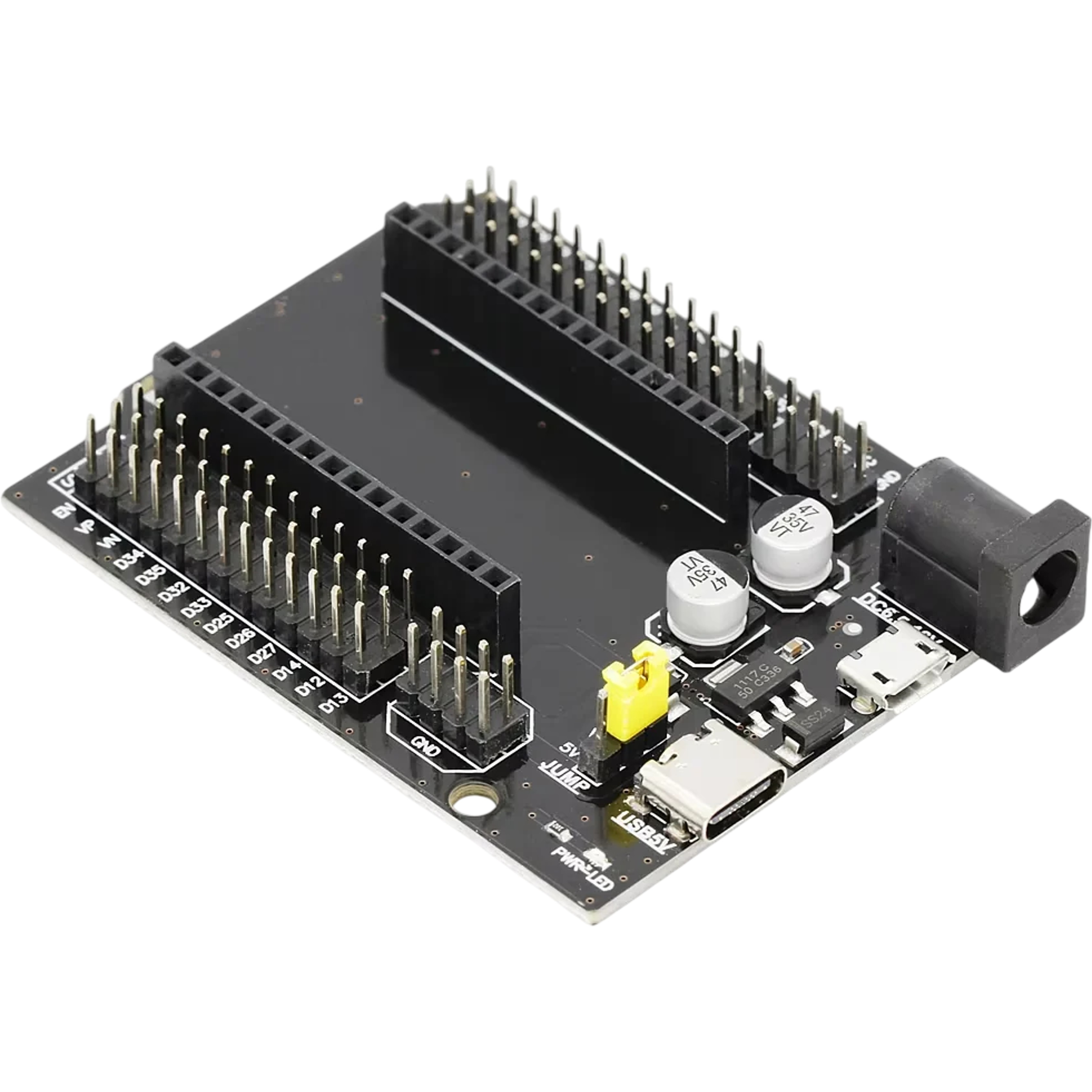
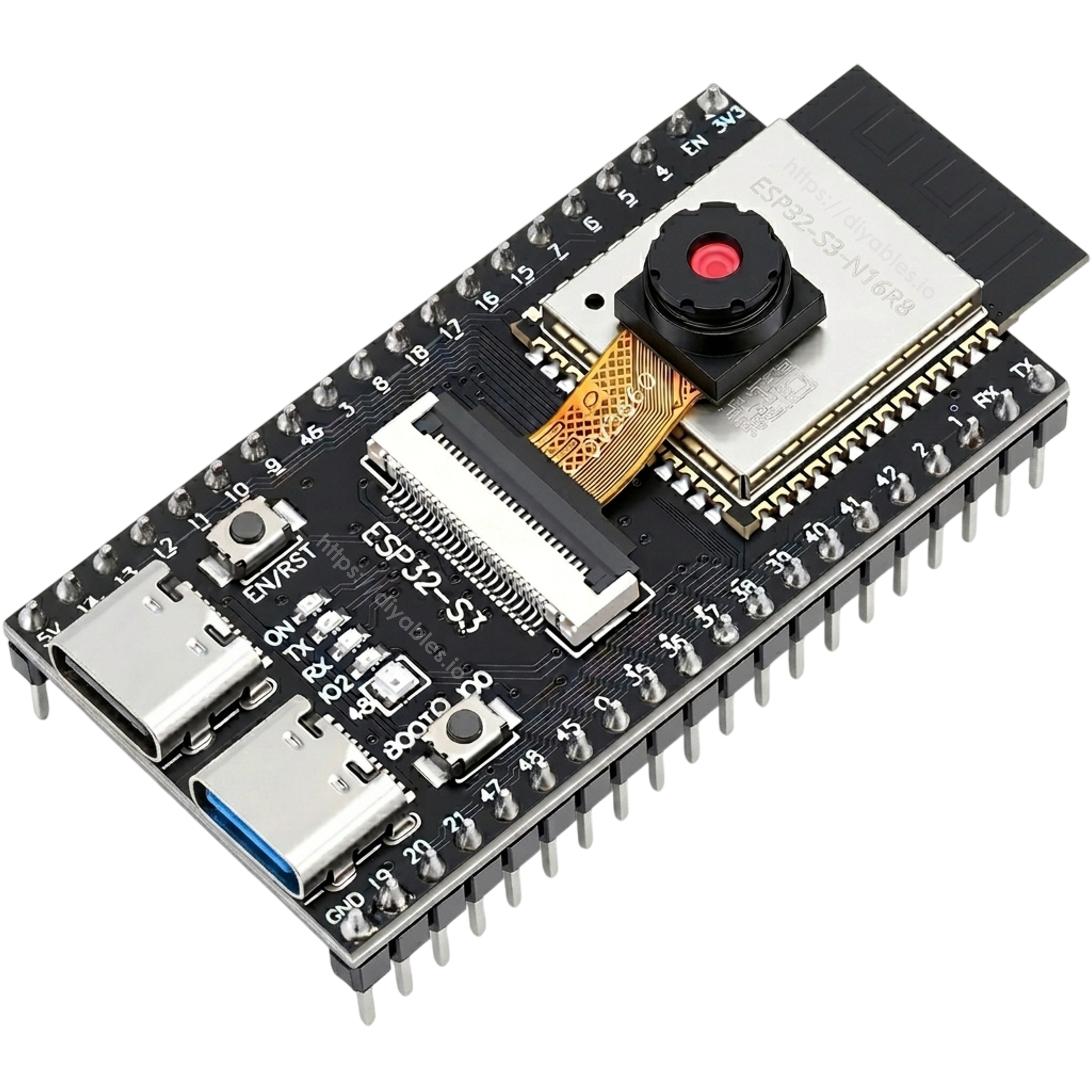
DIYables DIYables ESP32-S3 WROOM N16R8 CAM Development Board with OV3660 Camera, WiFi Bluetooth 5, Dual Type-C, 16MB Flash 8MB PSRAM, Presoldered
 Click to zoom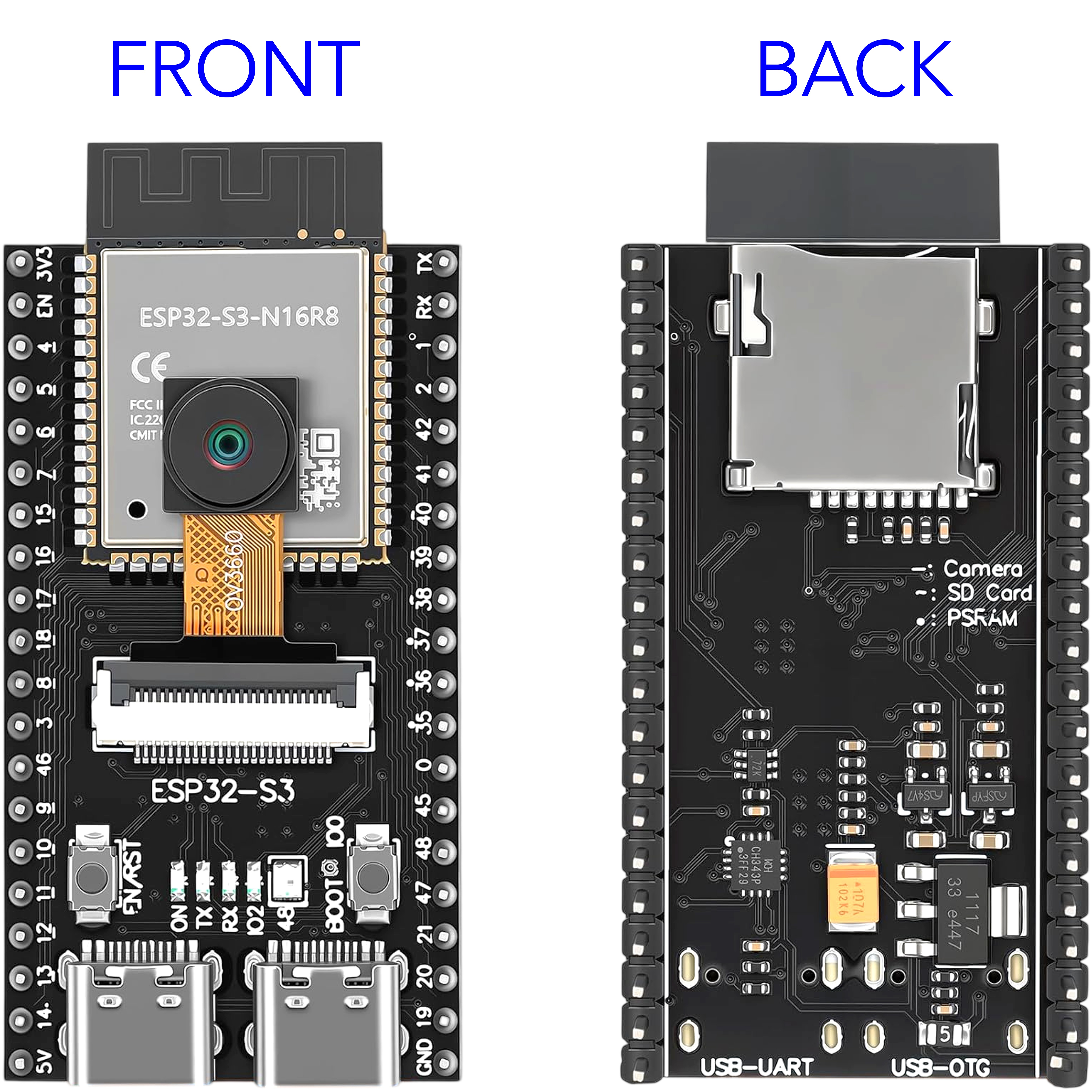


Quick Overview
The DIYables ESP32-S3 WROOM N16R8 CAM Development Board is a powerful all-in-one camera development platform built around the ESP32-S3-WROOM module with Xtensa 32-bit LX7 dual-core processor running up to 240 MHz. Equipped with an OV3660 3-megapixel camera module, this board is designed for AI vision applications including image capture, real-time video streaming, face recognition, object detection, and smart surveillance. It comes fully presoldered with headers and camera module attached, ready for immediate prototyping without any soldering required.
The board features 16MB of Flash and 8MB of PSRAM, providing ample storage and memory for complex embedded systems, camera frame buffers, and advanced AI inference tasks. Wireless connectivity is covered by dual-band 2.4 GHz WiFi (802.11 b/g/n) and Bluetooth 5.0 including BLE and Mesh networking, with high power mode up to 20 dBm for reliable long-range communication. Two Type-C USB ports serve different functions — one for USB-to-UART programming and serial monitoring, and one for native USB OTG — making flashing and debugging straightforward.
Ideal for smart surveillance systems, face recognition kiosks, AI-powered IoT devices, video streaming applications, wildlife monitoring cameras, and vision-based robotics. Compatible with Arduino IDE (with ESP32 board package), ESP-IDF, and MicroPython, making it accessible to both beginners and advanced developers building camera-enabled connected projects.
Key Features
- Presoldered Ready to Use — Fully assembled with pre-soldered headers and OV3660 camera module for immediate prototyping without additional soldering
- Dual-Core LX7 Processor — Xtensa 32-bit LX7 dual-core processor up to 240 MHz delivers high performance for AI inference, image processing, and IoT tasks
- 3MP OV3660 Camera Module — Built-in OV3660 3-megapixel camera supports clear image capture and real-time video streaming for vision and surveillance projects
- WiFi and Bluetooth 5.0 — Supports WiFi 802.11 b/g/n and Bluetooth 5 including BLE and Mesh with up to 20 dBm high power mode for reliable wireless connectivity
- 16MB Flash and 8MB PSRAM — Large memory capacity for complex firmware, camera frame buffers, and advanced AI and machine learning applications
- Dual Type-C USB Ports — One for USB-to-UART programming and one for native USB OTG, enabling easy code upload, serial monitoring, and USB device functionality
- Arduino IDE Compatible — Works with Arduino IDE after installing the ESP32 board package; also supports ESP-IDF and MicroPython
- Rich Peripheral Interfaces — Provides UART, SPI, I2C, PWM, ADC, and multiple GPIO pins for connecting sensors, displays, motors, and expansion modules
- AI and Vision Ready — Ample PSRAM and processing power support TensorFlow Lite, face detection, face recognition, and object classification workloads
- Versatile Applications — Ideal for smart cameras, surveillance, face recognition, video streaming, robotics, and connected IoT vision systems
- ...NOTE
- If you are using analog sensors with this board, configure the ADC with 11 dB attenuation to set the voltage reference range to handle up to 3.3V.
- ...NOTE
- ...WARNING
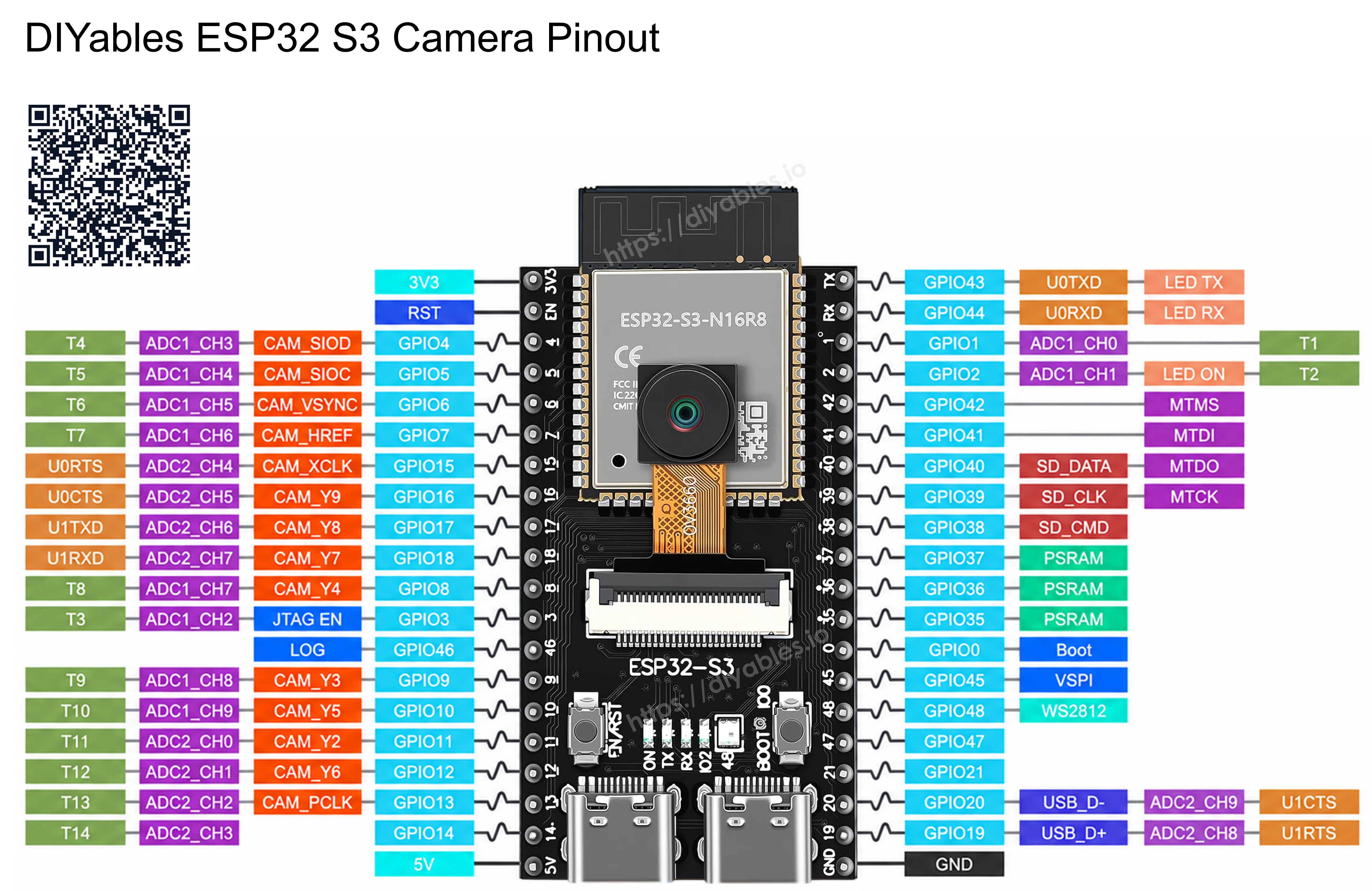
- Special Pins on ESP32-S3 – Avoid if you are a beginner
- 1. Boot/Strapping Pins: GPIO0, GPIO3, GPIO45, GPIO46
- These pins are sampled during startup to control boot mode and code flashing. An incorrect connection can prevent the board from booting or uploading code.
- Recommendation: Avoid using GPIO0, GPIO3, GPIO45, and GPIO46 if you are a beginner. If you must use them, always check the ESP32-S3 datasheet first.
- ...WARNING
SPECIFICATION
| Specification | Value |
|---|---|
| Product Type | ESP32-S3 Camera Development Board |
| Module | ESP32-S3-WROOM-N16R8 |
| Processor | Xtensa 32-bit LX7 dual-core, up to 240 MHz |
| Camera | OV3660, 3 megapixel |
| Flash Memory | 16MB |
| PSRAM | 8MB |
| Internal SRAM | 512KB |
| WiFi | 2.4 GHz IEEE 802.11 b/g/n |
| Bluetooth | Bluetooth 5.0, BLE, Mesh |
| TX Power | Up to 20 dBm (high power mode) |
| USB Ports | Dual Type-C (USB-to-UART + native USB OTG) |
| Headers | Pre-soldered, ready to use |
| Operating Voltage | 3.3V (powered via 5V USB Type-C) |
| Interfaces | UART, SPI, I2C, PWM, ADC, GPIO |
| IDE Support | Arduino IDE, ESP-IDF, MicroPython |
| Package Quantity | 1 piece |
| Compatibility | Arduino IDE (ESP32 board package), ESP-IDF, MicroPython |
| Applications | Smart camera, face recognition, object detection, video streaming, IoT vision, surveillance, AI robotics |
Tutorials
- ESP32 S3 - Camera
- ESP32 S3 Camera - Save Photo to SD Card Every Few Seconds
- ESP32 S3 Camera - Save Photo to SD Card When Motion Detected
- ESP32 S3 Camera - Save Photo to SD Card When Door Opens
- ESP32 S3 Camera - Save Video to Micro SD Card
- ESP32 S3 Camera - Send Photo to Telegram When Motion Detected
- ESP32 S3 Camera - Send Photo to Telegram When Door Opens
- ESP32 S3 Camera - Send Photo to Email When Motion Detected
- ESP32 S3 Camera - Smart Video Doorbell with a Button
- ESP32 S3 Camera - Detect Motion Without a Sensor
- ESP32 S3 Camera - Save Battery with Deep Sleep
- ESP32 S3 Camera - Browse Photos on SD Card from Web Browser
- ESP32 S3 Camera - Show Live Video on a TFT Display
- ESP32 S3 Camera - Send Live Video to Python on PC
- ESP32-S3 - Other Components Tutorials
COMPATIBLE HARDWARE
- OV3660 Camera Module — Built-in 3MP camera for image capture and video streaming (included on board)
- OLED displays (I2C/SPI) — Display camera status, sensor data, or debug information
- TFT LCD displays — Live video preview and UI for camera applications
- MicroSD card modules — Store captured images and video to SD card via SPI
- PIR motion sensors — Trigger camera capture on motion detection
- Servo motors — Pan-tilt camera mount control via PWM
- I2C sensors (temperature, humidity, etc.) — Environmental monitoring alongside camera data
- BLE devices and smartphones — Wireless image transfer and remote camera control via Bluetooth
- WiFi routers and MQTT brokers — Cloud-connected camera streaming and IoT integration
- AWS IoT, Azure IoT, Google Cloud — Cloud AI vision and storage services
- USB hosts (via USB OTG) — Connect USB peripherals through the native USB port
- 3.3V power modules — External power supply for standalone camera deployments
FRITZING PART
- Download DIYables ESP32-S3 N16R8 CAM Fritzing Part (.fzpz) — Import into Fritzing to draw wiring diagrams and breadboard layouts with this board