DIYables PC817 1 Channel Optocoupler Isolation Module
 Click to zoom


Quick Overview
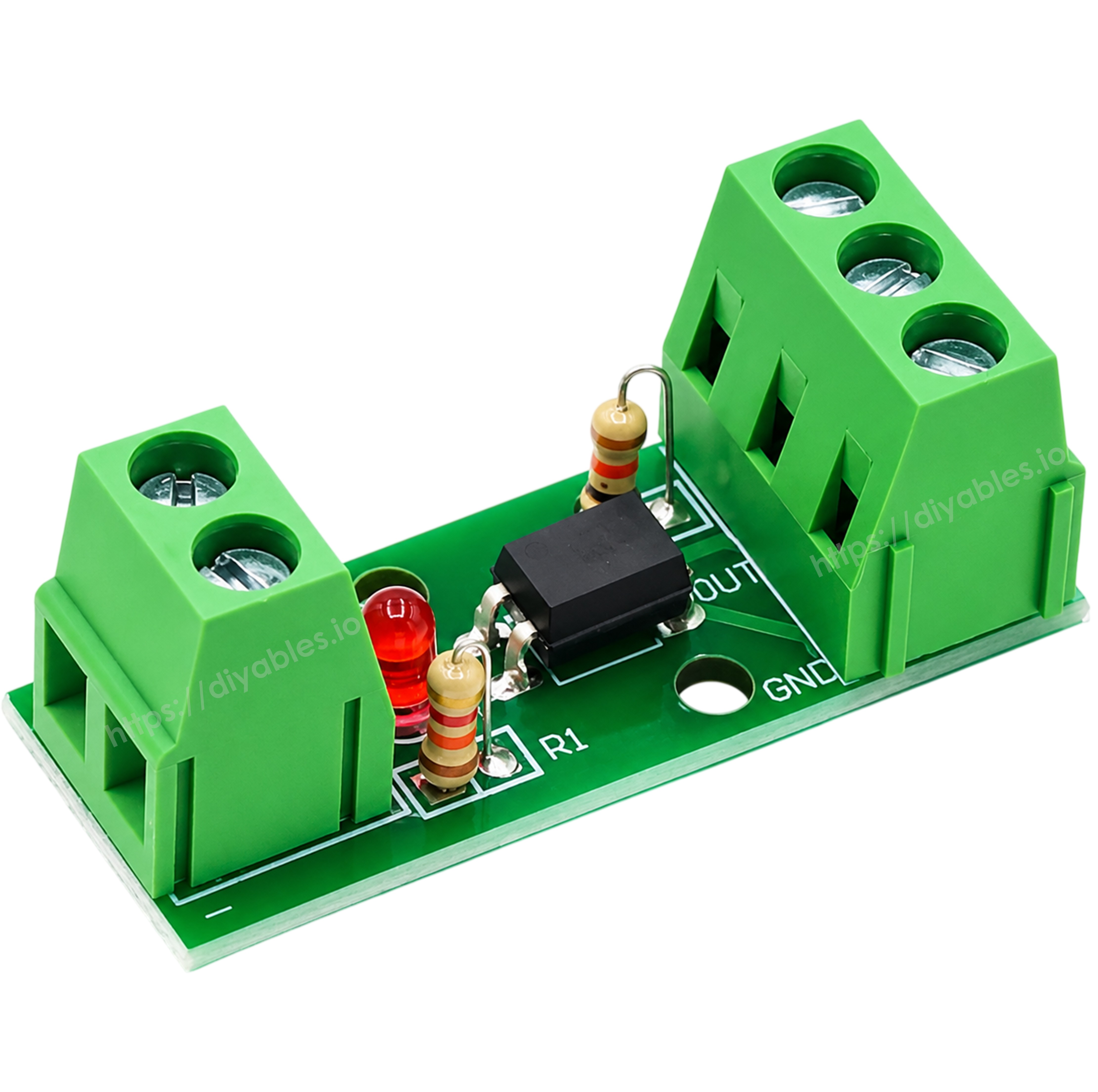
The DIYables PC817 (EL817) 1-Channel Optocoupler Isolation Module provides reliable electrical isolation of over 3000V between your microcontroller and high-voltage or inductive loads. With a DC 12V input and a wide DC 1.8V–24V output range, this module bridges the voltage gap between low-voltage MCU outputs and higher-voltage driven devices such as motors, relays, and solenoids. The 5.0mm pitch screw terminals make wiring fast and secure.
This module functions as both an optocoupler isolator and a level converter — supporting NPN-to-PNP and PNP-to-NPN signal conversion. It protects sensitive MCU circuits from interference and back-EMF generated by inductive loads, and supports input signal frequencies up to 5KHz for motor speed control and pulse-based applications. Operating temperature ranges from -55°C to 110°C, with a maximum input and output current of 50mA.
Ideal for PLC interfacing, motor drive isolation, MCU-to-relay signal conversion, industrial signal conditioning, and any application requiring galvanic isolation between control logic and power circuits using Arduino, ESP32, ESP8266, or Raspberry Pi.
Key Features
- 3000V+ Isolation Voltage — EL817/PC817 optocoupler provides over 3000V galvanic isolation protecting MCU circuits from inductive load interference and voltage spikes
- 12V Input Wide Output — Accepts DC 12V input with a wide DC 1.8V–24V output range for flexible level matching between MCUs and high-voltage driven modules
- NPN PNP Signal Converter — Converts NPN to PNP and PNP to NPN signal levels enabling clean isolation between MCU outputs and motors, relays, and solenoids
- 5.0mm Pitch Screw Terminals — Tool-friendly 5.0mm pitch screw terminals for secure, reliable wiring connections without soldering
- 5KHz Max Signal Frequency — Supports input signal frequencies up to 5KHz for motor speed control, PWM, and pulse-counting applications
- Wide Temperature Range — Rated for operating temperatures from -55°C to 110°C for reliable use in harsh and industrial environments
- Compact 40.3mm x 14.9mm PCB — Small form factor fits easily into enclosures, DIN rail holders, and tight control panel installations
- 50mA Max Output Current — Supports up to 50mA output current for direct interfacing with PLC inputs, optocoupler-driven relays, and logic gate inputs
- 5 Pack Value — Includes 5 complete isolation modules for multi-channel projects, redundant installations, or prototyping
- Versatile Applications — Suitable for PLC interfacing, motor drive isolation, MCU signal conditioning, level conversion, and industrial automation
SPECIFICATION
| Specification | Value |
|---|---|
| Product Type | 1-Channel Optocoupler Isolation Module |
| Optocoupler Chip | PC817 (EL817) |
| Channels | 1 |
| Isolation Voltage | >3000V |
| Input Voltage | DC 12V |
| Output Voltage | DC 1.8V – 24V (wide range) |
| Max Input Current | 50mA |
| Max Output Current | 50mA |
| Max Signal Frequency | 5KHz |
| Operating Temperature | -55°C to 110°C |
| Terminal Type | 5.0mm pitch screw terminals |
| PCB Dimensions | 40.3mm × 14.9mm |
| Weight | 8g (per module) |
| Package Quantity | 5 pieces |
| Compatibility | Arduino, ESP32, ESP8266, Raspberry Pi, PLC, AVR, ARM |
| Applications | PLC interfacing, motor drive isolation, NPN/PNP conversion, signal conditioning, MCU protection |
PACKAGE
A package includes:
| Qty | Items |
|---|---|
| 5 | PC817 1-Channel Optocoupler Isolation Module |
Tutorials
- Arduino - PC817 Optocoupler
- Arduino Uno R4 - PC817 Optocoupler
- Arduino Uno Q - PC817 Optocoupler
- Arduino Nano - PC817 Optocoupler
- Arduino Nano ESP32 - PC817 Optocoupler
- Arduino Nano 33 IoT - PC817 Optocoupler
- Arduino Mega - PC817 Optocoupler
- Arduino MKR WiFi 1010 - PC817 Optocoupler
- Arduino Giga R1 WiFi - PC817 Optocoupler
- Arduino MicroPython - PC817 Optocoupler
- ESP32 - PC817 Optocoupler
- ESP32-S3 - PC817 Optocoupler
- ESP32-C3 - PC817 Optocoupler
- ESP32 MicroPython - PC817 Optocoupler
- ESP8266 - PC817 Optocoupler
- Raspberry Pi - PC817 Optocoupler
- Raspberry Pi Pico - PC817 Optocoupler
COMPATIBLE HARDWARE
- Arduino boards (UNO, Mega, Nano, etc.) — digital output to isolated load control
- Arduino Uno R4 WiFi/Minima — digital output isolation
- ESP32 development boards — 3.3V MCU output to 12V isolated drive
- ESP8266 boards (NodeMCU, Wemos D1, etc.) — 3.3V MCU output isolation
- Raspberry Pi (all models) — 3.3V GPIO output isolation
- PLC digital output modules — signal isolation and level conversion
- Motor driver boards — isolated MCU-to-driver signal interface
- Relay modules — optocoupler-to-relay drive isolation
- Any microcontroller with digital GPIO output — NPN or PNP signal isolation